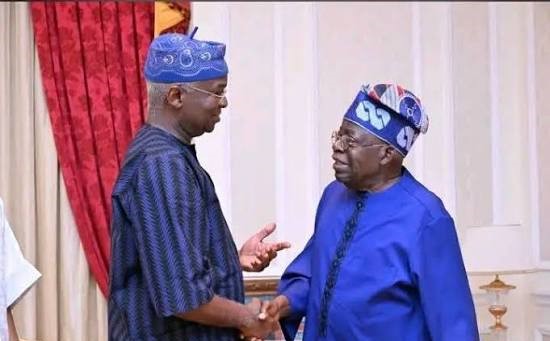
Former Lagos State Governor Babatunde Fashola has publicly advocated for the re-election of President Bola Tinubu, citing the administration’s structural reforms as essential for Nigeria’s long-term stability. Speaking on Channels Television’s Politics Today on Tuesday, the former governor argued that the policies introduced during Tinubu’s first term warrant continuation rather than abandonment. Fashola, who succeeded Tinubu as Lagos governor in 2007, listed several initiatives including the reviewed minimum wage, the student loan scheme overseen by the Nigerian Education Loan Fund (NELFUND), and the harmonisation of tax laws. He also pointed to stamp duty waivers on lease agreements and the introduction of compressed natural gas (CNG) as evidence of progress.
Fashola acknowledged that there are visible gaps between policy implementation and immediate results, but he maintained that the impacts would become clear over time. He warned against aborting the current reform journey mid-term, describing such a move as an exchange for uncertain promises lacking assurances. The former governor, who also served as Minister of Works and Housing under President Muhammadu Buhari, emphasized that the economic hardship currently affecting Nigerians is not a result of these specific policies but rather a collective global challenge. He attributed the cost-of-living crisis to the world’s recovery from the COVID-19 pandemic and ongoing conflicts in Russia, Ukraine, and the Middle East.
A significant portion of Fashola’s argument focused on defending the removal of fuel subsidies, a move widely blamed by citizens for rising inflation. He asserted that maintaining the subsidy would cause Nigeria to lose vital foreign income. When addressing the opposition’s stance, Fashola specifically targeted African Democratic Congress (ADC) presidential candidate Atiku Abubakar. Abubakar has proposed a production-based petrol subsidy, promising to review crude oil supply commitments to make more oil available to domestic refineries. Fashola urged the opposition to argue on how to increase the benefits of existing reforms rather than proposing to revert to subsidies.
This endorsement adds to a growing campaign within the ruling All Progressives Congress (APC) to secure Tinubu’s re-election in the 2027 general elections. On 3 November, Minister of Education Tunji Alausa also noted that Tinubu should be elected based on his performance over the last three and a half years. As the election cycle intensifies, Fashola’s intervention highlights the internal debate over the pace and visibility of economic reforms versus immediate relief measures.