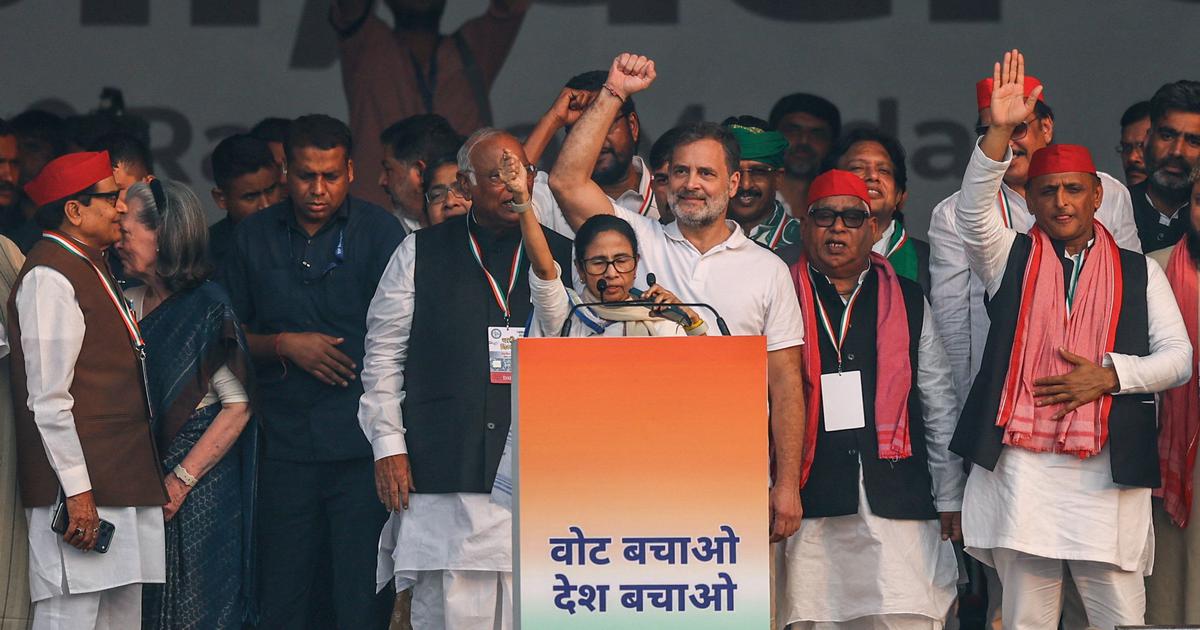
A recent analysis published by Scroll challenges the idea that India’s opposition can replicate the electoral successes achieved by the US Democratic Party during the recent midterm elections. The article argues that while American liberals celebrated the defeat of Donald Trump as a validation of democratic resilience, the structural realities of Indian politics make such outcomes improbable. Scroll’s commentary asserts that the equivalence between Indian and American political struggles is largely an oversimplification, noting that the circumstances in both nations are fundamentally different despite shared concerns regarding democratic backsliding.
The publication highlights that the American party system’s decentralization allows for significant internal renewal, a feature absent in India. Scroll points to the mayoral election of New York City, where Zohran Mamdani’s victory over party elites demonstrated how grassroots mobilization and ideological factions can reshape political agendas. The article explains that organized groups within the Democratic Party enable the testing and popularization of new ideas, creating a dynamic environment that can challenge established norms. This internal churn, combined with publicly administered primaries, moderates the gatekeeping power of party bosses and allows for the emergence of insurgent candidates.
In contrast, Scroll describes India’s political landscape as dominated by oligarchic, highly centralized parties that operate without internal democracy. The analysis notes that Indian parties are run top-down, often through dynastic hierarchies, and do not conduct internal elections. Consequently, nominations are distributed by powerful party bosses to favored acolytes rather than won through competitive processes. This structure leaves little room for rebellious radicals or new social coalitions to gain traction. The article suggests that while Indian opposition leaders may express relief at US political developments, their own parties remain hollow electoral brands with no mechanism for internal renewal or significant challenge to the ruling Bharatiya Janata Party.
Scroll further distinguishes the operational styles of Prime Minister Narendra Modi and Donald Trump, arguing that Modi’s approach is more measured and incremental, backed by a well-organized movement. The publication notes that while both leaders have contributed to declines in global democracy rankings, the institutional frameworks they operate within differ significantly. America’s mainstream media and judiciary, though imperfect, retain more independence than their Indian counterparts. The article concludes that the open nature of the American party system provides scope for the kind of political disruption that has reshaped US politics, a scope that remains closed in India’s ossified political environment.