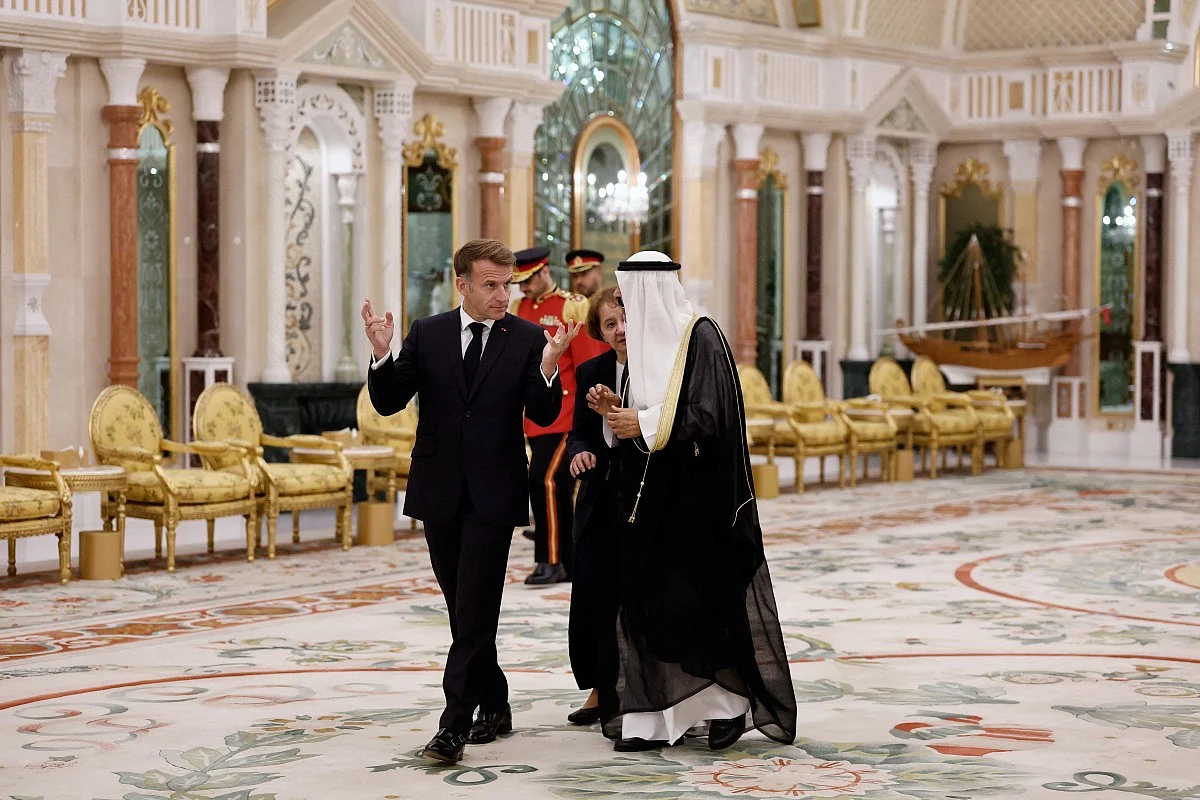
French President Emmanuel Macron began a four-nation tour of the Gulf on Monday, starting with an official visit to Kuwait. According to Khaleej Times, the trip is designed to secure oil and diesel supplies to lower prices in France, a move prompted by recent violent protests over rising living costs. Macron was welcomed in Kuwait by Emir Sheikh Mishal Al-Ahmad Al-Jaber Al-Sabah, with whom he discussed bilateral economic and trade relations. Asharq Al-Awsat reported that the tour extends through Wednesday, including stops in the United Arab Emirates, Bahrain, and Qatar, with a primary focus on restoring freedom of navigation through the Strait of Hormuz.
In the UAE, Macron met with President Sheikh Mohamed bin Zayed Al Nahyan in Abu Dhabi. Khaleej Times reported that the two leaders explored expanding cooperation in energy, advanced technology, and artificial intelligence. They reaffirmed their commitment to joint projects and discussed regional developments, particularly the impact of the US-Iran war on maritime security. The French presidency stated that the goal is to secure specific commitments on diesel and oil volumes, with senior executives from TotalEnergies and Engie accompanying the president. Asharq Al-Awsat noted that Macron’s discussions in the UAE are expected to cover defense and emerging technologies, while his visit to Qatar will include participation in a climate-related event.
The tour comes at a critical time for France, which is experiencing some of its worst violence in years. Khaleej Times noted that more than 2,500 people were arrested after town halls and shops were looted, leading Macron to address the nation late on Sunday. He described the situation as "unbridled" violence and linked the economic strain to the repercussions of the Gulf conflict. Constitutional expert Benjamin Morel suggested that while the visit may project normality, it could also appear out of touch. Energy expert Francis Perrin expressed skepticism about the immediate impact on fuel prices, noting that the G7 had already agreed to draw up to 100 million barrels from strategic reserves in early October. The French government aims to diversify energy sources and transportation routes to limit the crisis's impact on households.