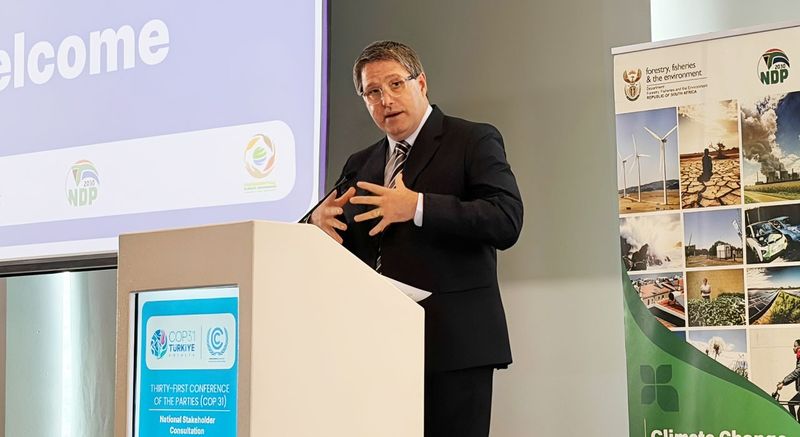
South Africa is positioning adaptation finance as a primary objective for the 31st United Nations Climate Change Conference, scheduled for November. According to Daily Maverick, the government aims to move beyond traditional mitigation strategies in response to a year marked by extreme weather events across the developing world. Forestry, Fisheries and the Environment Minister David Maynier stated that the country’s negotiators would advocate for a benchmark to triple adaptation finance by 2035 and operationalize the global goal on adaptation.
The urgency of this mandate is driven by recent domestic climate shocks. Daily Maverick reported that historic floods in Limpopo and Mpumalanga in January killed at least 30 people and damaged thousands of homes. Subsequently, the Western Cape experienced severe weather four months later, resulting in 11 fatalities and displacing over 200,000 residents. An unfolding Super El Niño phenomenon now threatens a hotter, drier summer, characterized by drought, wildfires, and water shortages. These conditions place significant pressure on the government to safeguard residents from a warming climate.
In addition to adaptation, South Africa is seeking to bolster the Fund for Responding to Loss and Damage. The country is one of 119 nations that have submitted more than 170 funding proposals to this mechanism. Maynier noted that South Africa submitted a $20-million proposal to restore flood-affected conservation landscapes in the Kruger National Park. Maesela Kekana, the deputy director-general for climate change, indicated that the negotiating team would also seek assistance from financial institutions outside the United Nations Framework Convention on Climate Change, such as the Clean Investment Fund.
The negotiations coincide with the start of the second Global Stocktake, a process that assesses progress toward the Paris Climate Agreement. Daily Maverick noted that a recent United Nations Environment Programme report found that a 1.5°C temperature overshoot is now widely unavoidable. This report proposed an "overshoot, peak and decline" strategy to minimize risks of extreme weather and ecosystem loss. Maynier argued that the stocktake should evaluate progress beyond emissions reductions, focusing instead on climate finance, technology transfer, and capacity building for developing countries.