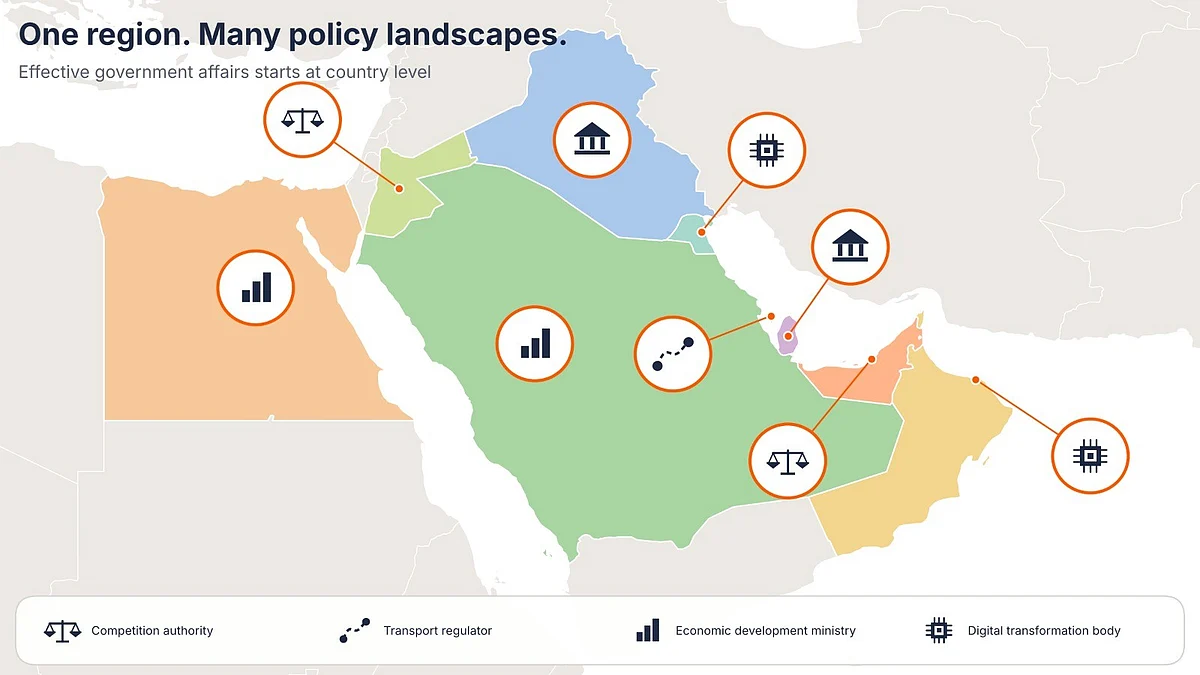
Multinational corporations operating in the Middle East are being advised to abandon unified regional advocacy strategies in favor of country-specific approaches that account for distinct national priorities. According to a report published by Khaleej Times, many global technology firms enter the region with the assumption that their existing international frameworks can be adapted with minimal local adjustments. This often leads to unexpected challenges, such as product launch delays or regulatory conflicts, when businesses overlook the unique economic and institutional landscapes of individual nations.
The article, authored by May Youssef, Senior Director of Corporate Affairs at talabat, illustrates this pitfall through a hypothetical scenario where a tech company fails to launch a product because it underestimated local regulatory requirements. The report argues that corporate advocacy has evolved beyond simple lobbying or relationship management. It now requires a sophisticated understanding of how national development goals, such as industrial localization in Saudi Arabia or digital transformation in the UAE, directly impact commercial viability. "This is why geopolitical analysis alone is not enough," the document states, emphasizing that businesses must understand the specific priorities of individual institutions like competition authorities or economic ministries.
Regulatory environments in the region are described as rapidly evolving, particularly in sectors like artificial intelligence and autonomous mobility. The UAE, for instance, introduced a Charter for the Development and Use of Artificial Intelligence in 2024, setting principles for responsible innovation. Similarly, Dubai has implemented legislation for autonomous vehicles, with further provisions established in 2026 to govern safety and operational phases. These frameworks create opportunities for companies to contribute technical expertise while policies are still being shaped, rather than reacting to them after implementation.
The report stresses that effective government affairs must be integrated into core corporate strategy, including market entry and product development, rather than serving as a post-decision support function. Youssef notes that public affairs executives should have the authority to challenge internal commercial decisions if they risk regulatory concerns. The value of this function lies in helping businesses make better initial decisions by aligning their models with public policy objectives. The article concludes that long-term competitiveness depends on understanding what each government is trying to achieve and where a company can make a meaningful contribution, rather than simply maintaining regional relationships.