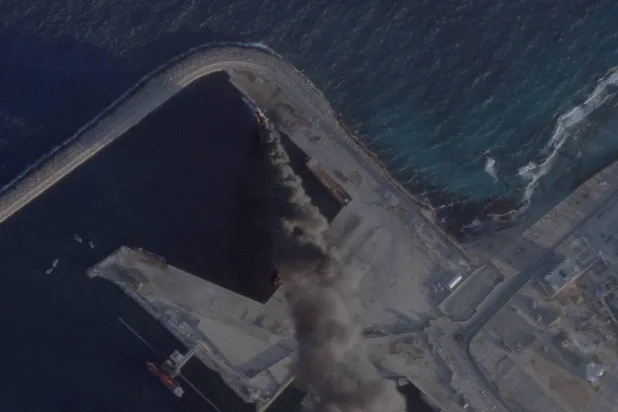
Libya’s eastern-based government reported on Sunday that a preliminary investigation indicated a suspected drone attack caused an explosion aboard a Russian ship docked at the port of Benghazi. The vessel had stopped at the naval base to refuel and resupply while returning to Russia under maritime cooperation agreements between the two nations. Two medical sources confirmed that while no deaths were reported, several individuals sustained injuries. The exact number and nationalities of those injured remained unknown at the time of reporting.
The eastern government strongly condemned the suspected attack, describing it as a direct violation of Libya’s sovereignty and a threat to maritime safety. Officials stated that port and naval base facilities, including warehouses, remained safe and that normal operations had resumed after the fire was controlled and the site secured. The government pledged to take legal and diplomatic measures against any party found responsible for the blast.
In its statement, the eastern-based administration emphasized that Libya is not a party to the war between Russia and Ukraine or any armed conflict beyond its borders. It asserted that relations with friendly countries are a sovereign matter and warned that Libyan ports and territorial waters would not be used as arenas for settling international scores. This stance comes as Ukrainian forces have increasingly targeted Russian assets far beyond the front lines, including strikes in the Black Sea and the Mediterranean.
There was no immediate claim of responsibility for the strike, nor was there an immediate reaction from Russian authorities. The incident follows a pattern of long-range barrages by Ukrainian forces against Russian infrastructure. In March 2026, Russia accused Ukraine of attacking an LNG tanker with naval drones launched from the Libyan coast, though precise details of that event were not fully clarified. The current blast in Benghazi adds to the complexity of maritime security in the region.
The eastern government’s response highlights the delicate balance Tripoli’s rivals maintain with external powers. By framing the incident as an attack on Libyan sovereignty rather than a proxy conflict, the administration seeks to assert its authority over territorial waters. The lack of immediate attribution leaves the international community to speculate on the perpetrators, with some observers pointing to the broader geopolitical tensions involving Russia and Ukraine.