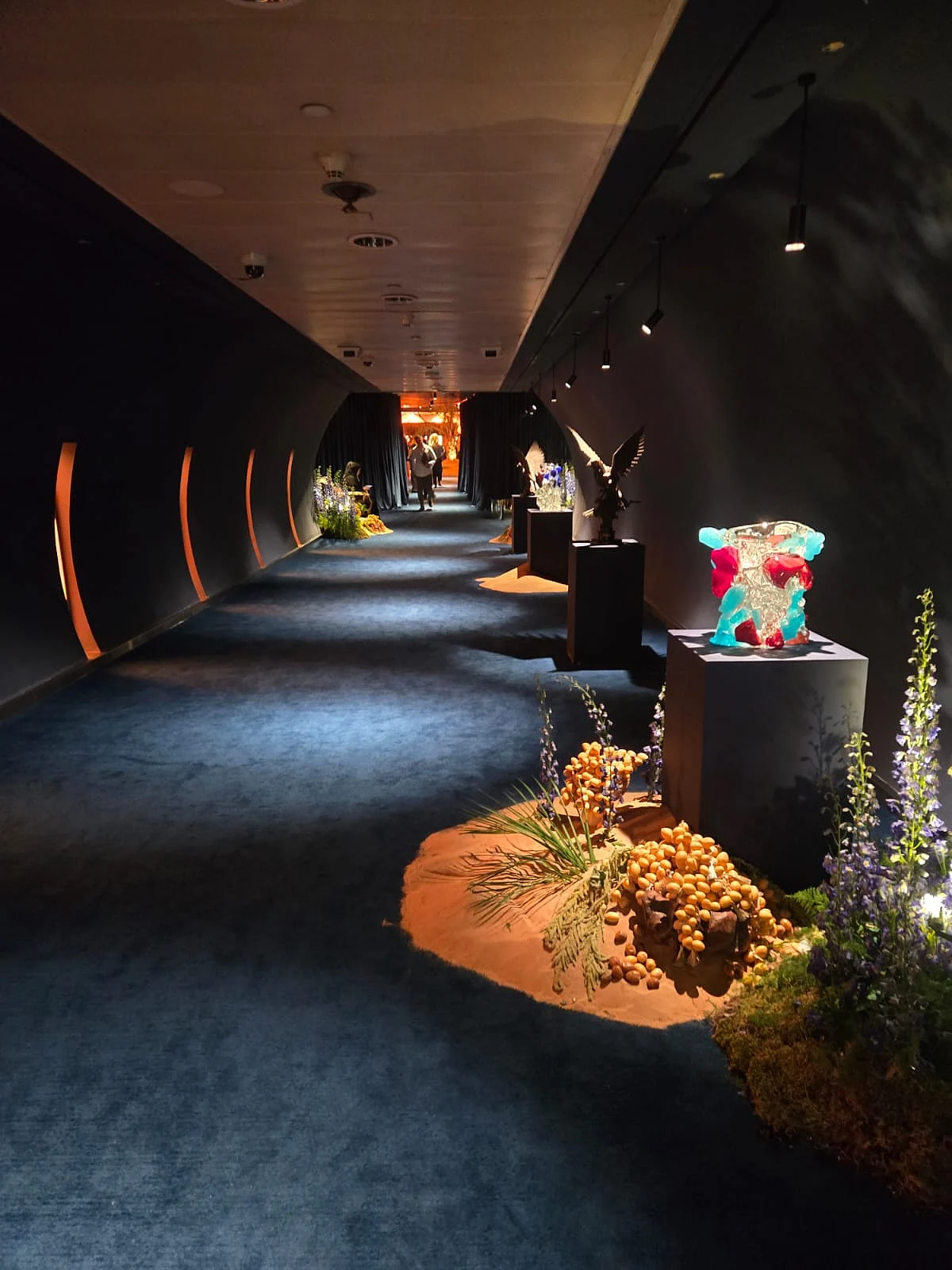
The second edition of Nomad Abu Dhabi is currently underway at Terminal 1 of the former Abu Dhabi International Airport, according to Khaleej Times. The fair has repurposed the historic terminal to host more than fifty exhibitors who are presenting contemporary art, collectible design, jewellery, and craft. The venue provides a distinct backdrop for the works, which range from experimental furniture to pieces rooted in local heritage traditions.
Among the installations drawing attention is a transformed cement truck by artist Wim Delvoye. The work reimagines an ordinary construction vehicle as an elaborate structure resembling a palace or castle. A gallery representative noted that the piece initially distracts viewers with its grand appearance, only revealing its industrial origins upon closer inspection. This transformation of everyday objects into high art is a central theme of the fair’s curation.
Another significant installation is located at the Tashkeel booth, featuring a series of small mosque structures. Artist Shamin Sharum created the pieces to explore the concept of axonometric projection, a technique for representing three-dimensional structures on a flat surface. By shifting two-dimensional drawings into physical forms, Sharum created an optical illusion where the buildings appear to lean at impossible angles from certain viewpoints but straighten when viewed from another. Sharum explained to Khaleej Times that he wanted to create a way to see projection as an axonometric in real life. The structures represent various prayer spaces, including a recreation of the demolished Rashid and Fatima Mosque, rebuilt through memory and photography.
The fair also highlights the intersection of traditional craftsmanship and modern technology. At the Super Loop booth, consultant Hamza Lachhab presented a collection called Crossings, which combines materials such as fibreglass, mirror glass, and 3D-printed elements. The collection aims to connect different artists and artisans across Asia, the Mediterranean, and the Gulf. Similarly, the Irthi Contemporary Crafts Council showcased the Al Taif collection, which incorporates Emirati Talli, a traditional braiding technique, into contemporary furniture pieces made from mahogany and beechwood.
Other galleries presented works that play with perception and materiality. The A/P Room featured a cabinet by designer Eva Szumilas, inspired by gravitational pull, and a historic desk. Galerie Gastou displayed glass and bronze works based on the concept of a mirage, alongside antique rings dating back to 200 BC. The event underscores a growing interest in design that bridges historical craft with contemporary artistic expression.