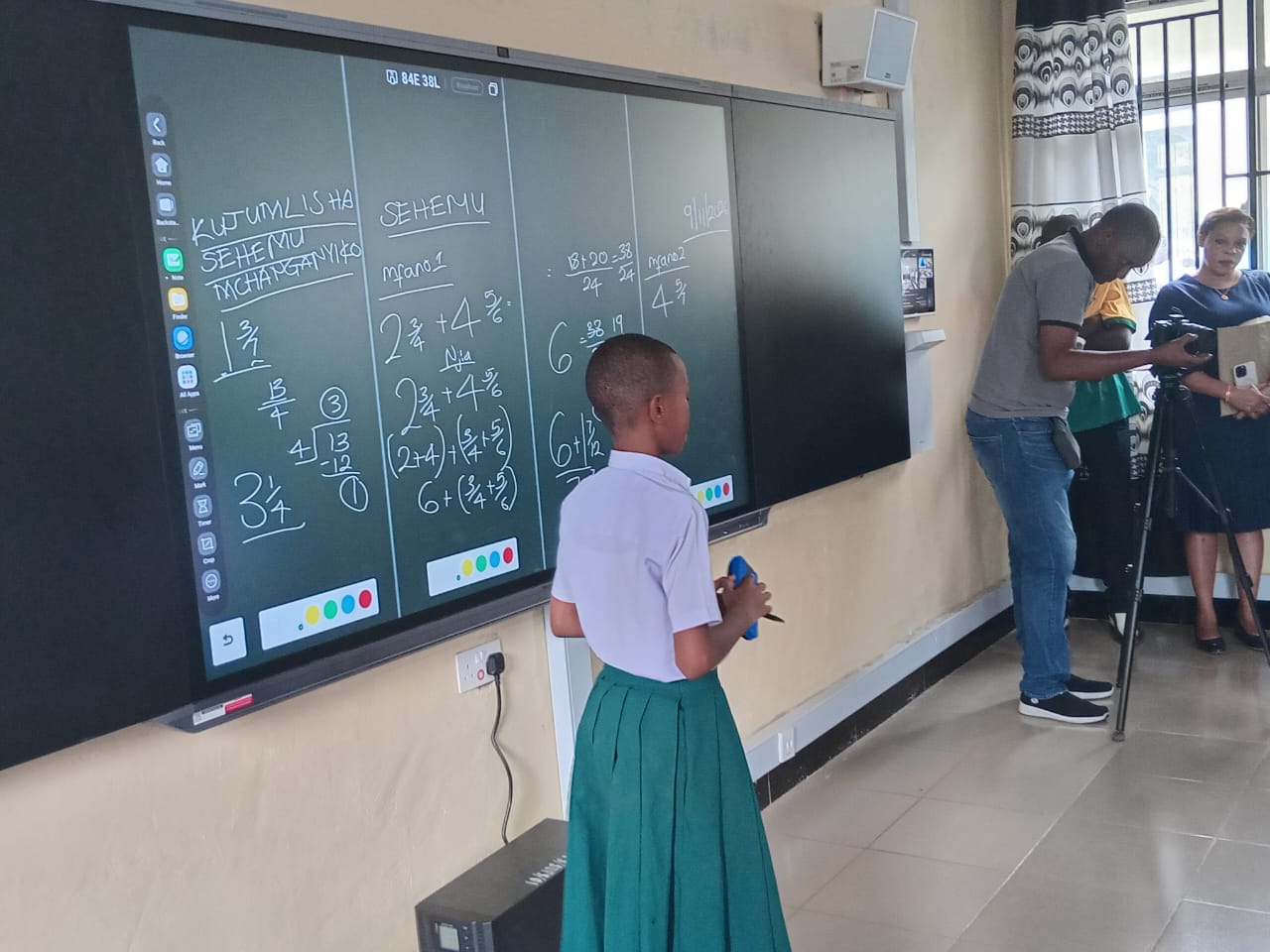
The Tanzanian government has fundamentally altered primary education infrastructure through the four-year BOOST Primary Student Learning Programme, a 1.15 trillion shilling initiative that has introduced smart classrooms to 800 primary schools across all 26 regions. According to Daily News, Deputy Minister in the Prime Minister’s Office for Regional Administration and Local Government, Dr Festo Dugange, revealed that the program enables a single teacher to instruct more than one class simultaneously at schools equipped with Information and Communication Technology (ICT). This capability was demonstrated during an inspection at Samia Primary School in Mwanza, where a teacher taught students from two different primary schools located in separate wards at the exact same time using a smartboard.
The Daily News reported that between the 2022/23 and 2025/26 financial years, the government distributed ICT equipment worth 67.9 billion shillings to these 800 schools. Of this total, 600 schools received smartboards and smart classroom setups. Prior to this initiative under the Education Program for Results II (EPforR II), no primary school in Tanzania utilized smart classrooms or smartboards for teaching. The program has thus created a specialized revolution in educational technology usage, simplifying student instruction and reducing the impact of teacher shortages.
Beyond digital infrastructure, the BOOST project has delivered substantial physical construction outcomes. Dr Dugange stated that the initiative has facilitated the construction of over 16,000 classrooms, surpassing the initial target of 12,000. Additionally, 237.9 billion shillings was allocated to rehabilitate 1,059 dilapidated primary schools, while 53.9 billion shillings was used to renovate 369 others and rebuild 51 that were severely damaged. In the Mwanza Region specifically, 26 new schools have been built to catalyze ICT literacy among students.
Local officials and residents have noted significant improvements in educational outcomes. At Kigongo Primary School in Misungwi District, the pass rate for early childhood students increased from 95 percent in 2015 to 100 percent in 2026, attributed to the modern facilities. Chacha Joseph, headmaster of Samia Primary School, explained that the funding has enhanced the capacity of both students and teachers to utilize technology. He noted that Mwanza Region has become a leader in education, finishing second in the previous year’s standard seven examination pass rates despite having a large population of children. The government emphasized that teachers and parents must now unite to ensure students study well and maintain the new infrastructure.