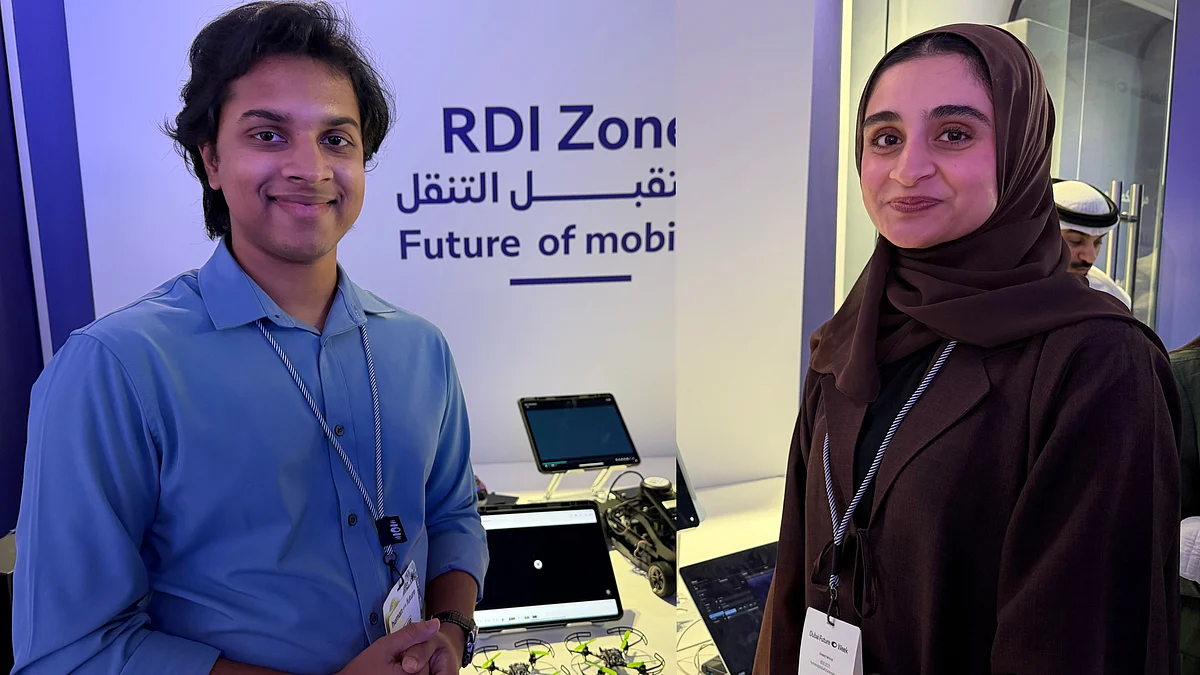
Students at Heriot-Watt University Dubai are presenting artificial intelligence projects that aim to simplify the operation of complex machinery through natural language and autonomous navigation. According to Khaleej Times, these initiatives include a drone-control system that interprets spoken instructions and a prototype race car that navigates tracks without a driver. The work is designed to make advanced technology accessible to users without specialist programming skills.
Aditya Shibu is leading the development of a drone system that allows operators to direct multiple aircraft using everyday language. Instead of coding specific flight paths or setting individual waypoints, an operator can simply state a task, such as inspecting a specific site. The team’s proprietary AI model interprets these commands and allocates tasks across the fleet. Shibu explained that the system decides the necessary actions based on the verbal input, moving beyond the choreographed formations typical of drone shows to support practical industrial work.
The proposed applications for this technology include infrastructure inspection for Dubai’s Roads and Transport Authority and Etihad Rail. Shibu described a concept where drones communicate with base stations to examine metro railway tracks, a capability that could prove useful during flooding events. The system could also be used for building inspections, allowing an operator to request an examination of a specific structural part without manually programming each aircraft. Current demonstrations show drones receiving instructions and traveling to designated locations, with plans to add cameras and other inspection equipment.
Shibu also noted that the interface could eventually include virtual reality and gesture control. Users might view battery status through a VR headset, while gloves enabling hand-movement control remain a longer-term ambition. The project seeks to bridge the gap between complex technical operations and intuitive human interaction.
In a separate project, the Atlas Racing team is working on an autonomous Formula race car. The team’s driving software has already been tested on a small prototype and a modified golf cart. Unlike vehicles that follow fixed routes, the prototype detects cones marking track boundaries and plans its path dynamically. Anosha, the team principal, stated that the vehicle must identify boundaries and calculate a route between them while managing steering and speed. The team, recognized by the Institution of Mechanical Engineers, won the FS-AI Real World Award at Formula Student UK in 2025. The next phase involves scaling the technology to a full-size vehicle.