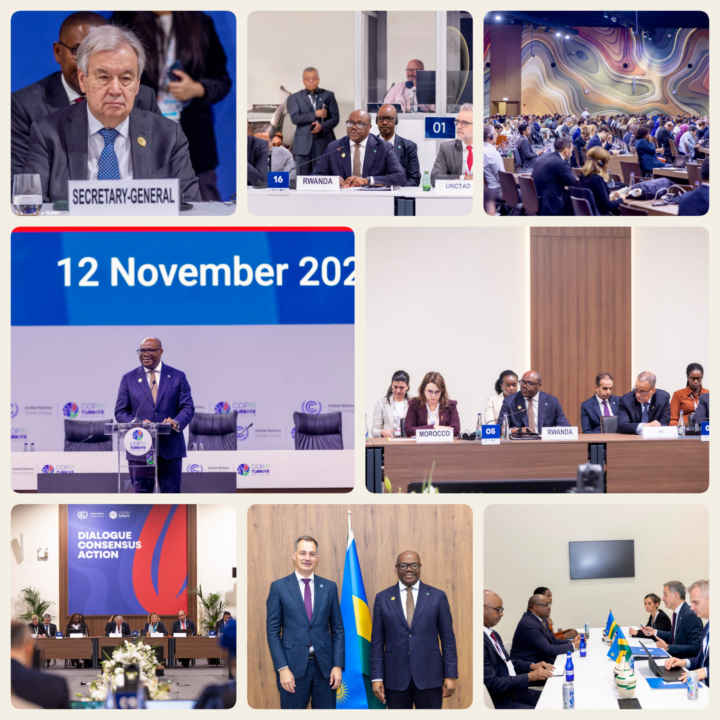
Rwanda’s Prime Minister Justin Nsengiyumva presented a $3.05 billion investment case at the COP31 climate conference in Türkiye, seeking international capital to upgrade electricity infrastructure and enhance urban resilience. The government outlined specific needs for grid expansion, wetland rehabilitation and climate-smart agriculture, arguing that national policy frameworks must be backed by accessible financing to deliver measurable results. Nsengiyumva participated in high-level dialogues on green industrialisation and global energy grids, where he highlighted Rwanda’s ambition to boost transmission capacity by 70 per cent and double regional electricity trade.
According to KT Press, Rwanda presented an estimated $1.3 billion requirement for grid infrastructure alone, calling on multilateral development banks to provide project financing. The Prime Minister also addressed the High-Level Dialogue on Urban Resilience, where he detailed a $195 million investment in Kigali’s flood-risk reduction. This includes the restoration of five wetlands covering approximately 500 hectares, designed to protect more than 220,000 residents from flooding while creating public green spaces. "Rehabilitation of five wetlands in Kigali will reduce" flood risks for these residents, Nsengiyumva stated, noting that nature-based solutions can deliver resilience at scale.
The Prime Minister emphasized that achieving these adaptation goals requires significantly increased financial support. He noted that developing countries need more than $300 billion annually for adaptation by 2035, which is up to 14 times the current level of support. "However, he said, achieving this requires financing," according to AllAfrica, pointing out that good plans do not automatically become bankable projects without removing barriers to capital flow. Rwanda welcomed Türkiye’s Sustainable Urban Resilience Financing Facility (SURFF) as a model for turning climate objectives into investable projects.
Rwanda’s broader climate strategy, outlined in its third Nationally Determined Contribution (NDC 3.0), commits to reducing emissions by 53 per cent by 2035 relative to business-as-usual scenarios. Meeting this target requires $12 billion in investment, 80 per cent of which is conditional on international support. The government highlighted the Green Gicumbi project, which has benefited approximately 249,000 people through landscape restoration and sustainable land management. Nsengiyumva argued that investments should be judged on their merits rather than their location, rejecting the perception that investments in the Global South carry higher risks. As Rwanda prepares to assume the chairmanship of the G77 and China in 2027, it reaffirmed its commitment to strengthening solidarity among developing nations in climate negotiations.