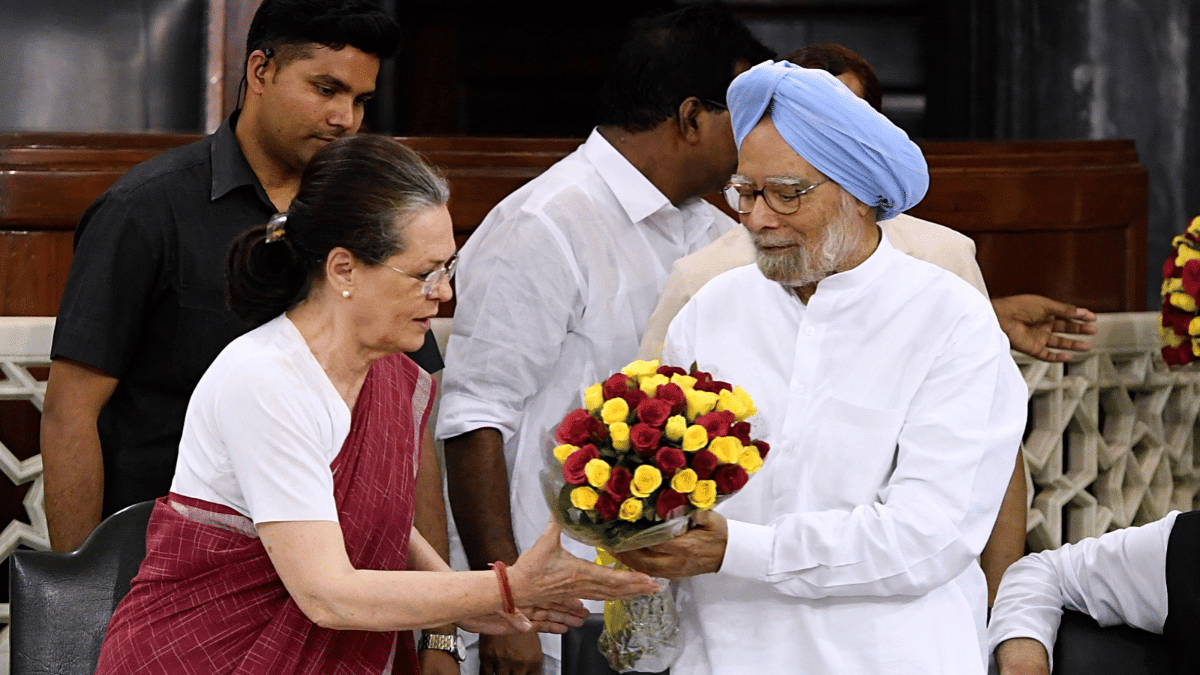
Sonia Gandhi has detailed the political calculations behind her selection of Manmohan Singh as prime minister in 2004, according to ThePrint. In her memoir, “Belonging, A journey of Love,” the former Congress president explained that the party’s reliance on Communist allies required a leader who could demonstrate a commitment to economic continuity. She argued that Singh’s established reputation in economic policy would help dispel doubts among voters and coalition partners about the government’s direction.
ThePrint reported that Gandhi described Singh as a figure above reproach with a deep understanding of India’s economy. She noted that while other candidates were qualified, Singh’s specific expertise aligned with the political necessity of the moment. The memoir highlights that Singh had previously introduced significant economic reforms in the early 1990s under Prime Minister P. V. Narasimha Rao, which lent credibility to his candidacy. Additionally, ThePrint noted that Singh was not aligned with any specific faction within the Congress, making him a neutral choice acceptable to senior colleagues who were consulted on the decision.
The book also addresses the internal dynamics of the Congress leadership during that period. Gandhi recounted the pressure she faced to assume the prime ministership herself, noting that she had already informed her children, Rahul and Priyanka, of her preference to remain as party president. ThePrint stated that her children’s resistance was partly influenced by the public scrutiny following the assassinations of their grandmother and father. Gandhi described the resulting arrangement as an unspoken division of responsibility, where Singh headed the government while she led the party.
According to ThePrint, a small inner circle held regular sessions with the prime minister to maintain alignment between the party and the executive. Gandhi explained that both she and Singh anticipated that political opponents would attempt to create friction between them. To manage this, they prioritized direct communication to resolve differences. The memoir concludes with Gandhi’s assertion that it was her duty to defer to Singh in matters of governance, a dynamic she described as working smoothly throughout their tenure.